Locked out at night is the worst time to learn you forgot to verify locksmith license and insurance. But that is exactly when bad operators count on rushed decisions, inflated prices, and zero accountability if something goes wrong.
A real locksmith should be ready for this question. Not offended by it. Not vague. Not stalling. If someone is coming to your home, business, or car, they should be able to show who they are, whether they are licensed where required, and whether they carry insurance that protects you if they damage your property.
Why verify locksmith license and insurance before the work starts
This is not paperwork for the sake of paperwork. It is basic protection.
A locksmith works on the barrier between you and everyone else. That means front doors, commercial entry points, safes, access systems, and vehicles. If the wrong person shows up, the risk is not just overpaying. It can mean poor workmanship, damage, missing keys, security gaps, or no recourse after the job.
Insurance matters because even skilled technicians can run into problems. A lock can fail during removal. A car door panel can get scratched. A commercial panic bar can be installed incorrectly and need correction. If the company is uninsured, the argument usually gets ugly fast.
Licensing is a little more complicated because requirements vary by state and city. Some areas regulate locksmiths tightly. Others do not. That means the smart move is not to assume every locksmith must have the same credentials everywhere. The smart move is to ask what is required in your area, then ask the company to prove they meet it.
How to verify locksmith license and insurance without wasting time
When you need help quickly, you do not want a lecture. You want a clean process.
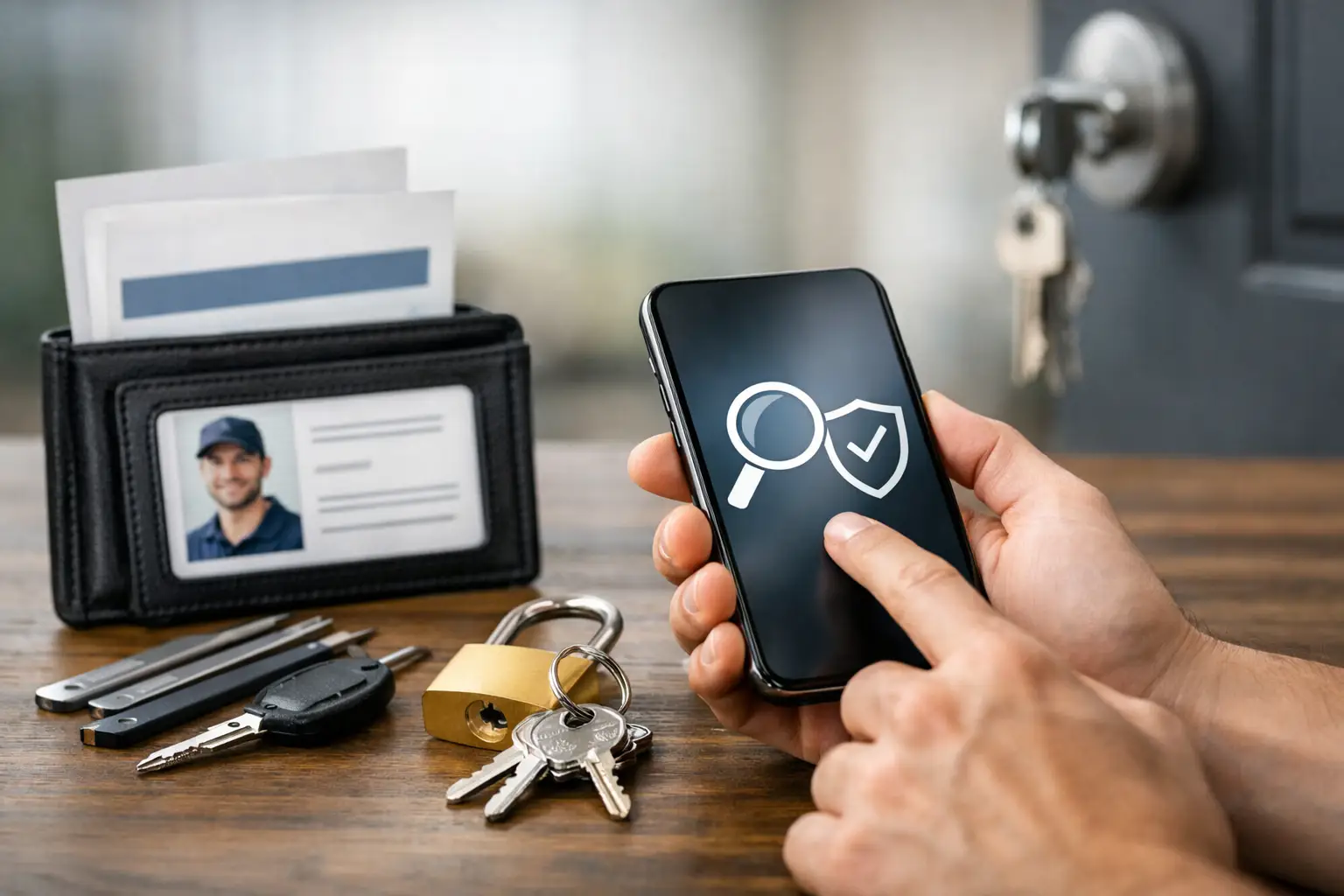
Start before dispatch if you can. Ask the company for the business name, the technician's name if available, and whether the locksmith is licensed in your area when licensing is required. Then ask for proof of insurance. If they dodge either question, move on.
When the technician arrives, check that the company name on the vehicle, invoice, or work order matches what you were told on the phone. Ask to see photo ID and any license or registration they claim to hold. If they say the proof is on file at the office but cannot show anything at all, that is a warning sign.
You do not need to turn this into an interrogation. You just need enough to confirm you are dealing with a real business that stands behind its work.
What to ask on the phone
Keep it simple. Ask, "Are you licensed for locksmith work in my area if a license is required?" Then ask, "Are you insured, and can the technician show proof when they arrive?" Finally ask for a full estimate range, including service call, labor, parts, after-hours charges, and any minimum fee.
That last part matters because scam operators often hide behind a low starting quote, then pile on charges once they are standing at your door. A legitimate company may not be able to give an exact total before seeing the lock, but they should be able to explain how pricing works in plain English.
What to check when the locksmith arrives
Look for consistency. Does the technician know your name, location, and the service requested? Is the vehicle marked or at least tied clearly to the company you called? Does the invoice list a business name, phone number, and itemized charges?
Then look at behavior. A trustworthy locksmith usually asks for proof that you have authority to access the property or vehicle. If someone is willing to open anything for anyone with no questions, that should bother you.
License rules depend on where you are
This is where people get tripped up. They hear "licensed locksmith" and assume there is one national rule. There is not.
In the US, locksmith regulation is handled at the state or local level. Some states require a locksmith license, registration, background check, or other approval. Some do not. In some places, a city or county may have rules even if the state does not. That is why you should avoid blanket statements from any company claiming every real locksmith must carry the exact same credential.
A better answer sounds like this: "Requirements vary by location. Here is what applies in your area, and here is our documentation." That is the kind of direct answer you want.
If you are in San Diego or anywhere else with mixed city, county, and state oversight on service trades, this matters even more. Local knowledge is part of professionalism.
Insurance is not optional in practice
Even if a customer never asks for it, a serious locksmith company should carry insurance. At minimum, you want to know the business has liability coverage. Depending on the company structure, there may also be commercial auto coverage and workers' compensation coverage.
You do not need to become an insurance expert during a lockout. What you need is proof that coverage exists and that it belongs to the company doing the work. If a technician says, "I have insurance," but the job is actually under a different business name, ask for clarification before work begins.
This is especially important for commercial jobs, apartment turnovers, and higher-value hardware. The more doors, keys, and people involved, the more costly a mistake can become.
Red flags that matter more than a cheap quote
Price still matters. Fair pricing matters a lot. But the lowest quote is meaningless if the company cannot prove who they are.
Watch for these patterns: a price that sounds unrealistically low, refusal to name the business clearly, no proof of insurance, pressure to start work before discussing cost, and a technician who wants to drill immediately without trying less destructive options first. Another bad sign is an invoice that suddenly changes from the phone quote with vague add-ons and no explanation.
It also depends on the job. A high-security commercial lock, smart lock setup, or car key programming may cost more than a standard house lockout. Higher price by itself is not the scam. Hidden pricing is the problem.
Why good locksmiths welcome verification
Honest companies know this industry has a trust problem. Too many customers have dealt with bait-and-switch pricing, mystery dispatchers, or technicians who showed up with no clear business identity.
That is why a good locksmith does not act annoyed when you ask questions. Verification protects both sides. It confirms you called a real business, and it gives the technician a cleaner job because expectations are clear before the tools come out.
Fast service and careful verification are not opposites. A professional company should be able to move quickly and still answer basic questions about credentials, coverage, and pricing.
If you are in a hurry, use this quick filter
If you only have a minute, ask four things before anyone is dispatched: what is the full business name, what is the estimated total cost range, can you verify locksmith license and insurance for my area, and will the technician show identification on arrival.
If the answers are straight, you are probably on the right track. If the answers are slippery, end the call.
That one minute can save you a blown lock, a surprise bill, or a stranger doing sensitive work on your property with no real backup behind them.
The goal is not paperwork - it is peace of mind
When you call a locksmith, you are usually under pressure. You may be standing outside your house, next to your car, or trying to secure a business before closing. That urgency is real. So is the risk of hiring the wrong person because you just want the problem gone.
The right move is simple: slow down for one minute, ask direct questions, and verify what can be verified before work begins. Fast help should still be accountable. Fair pricing should still be clear. And anyone trusted with your locks should be able to prove they are the real thing.
That is not asking too much. It is the minimum.