
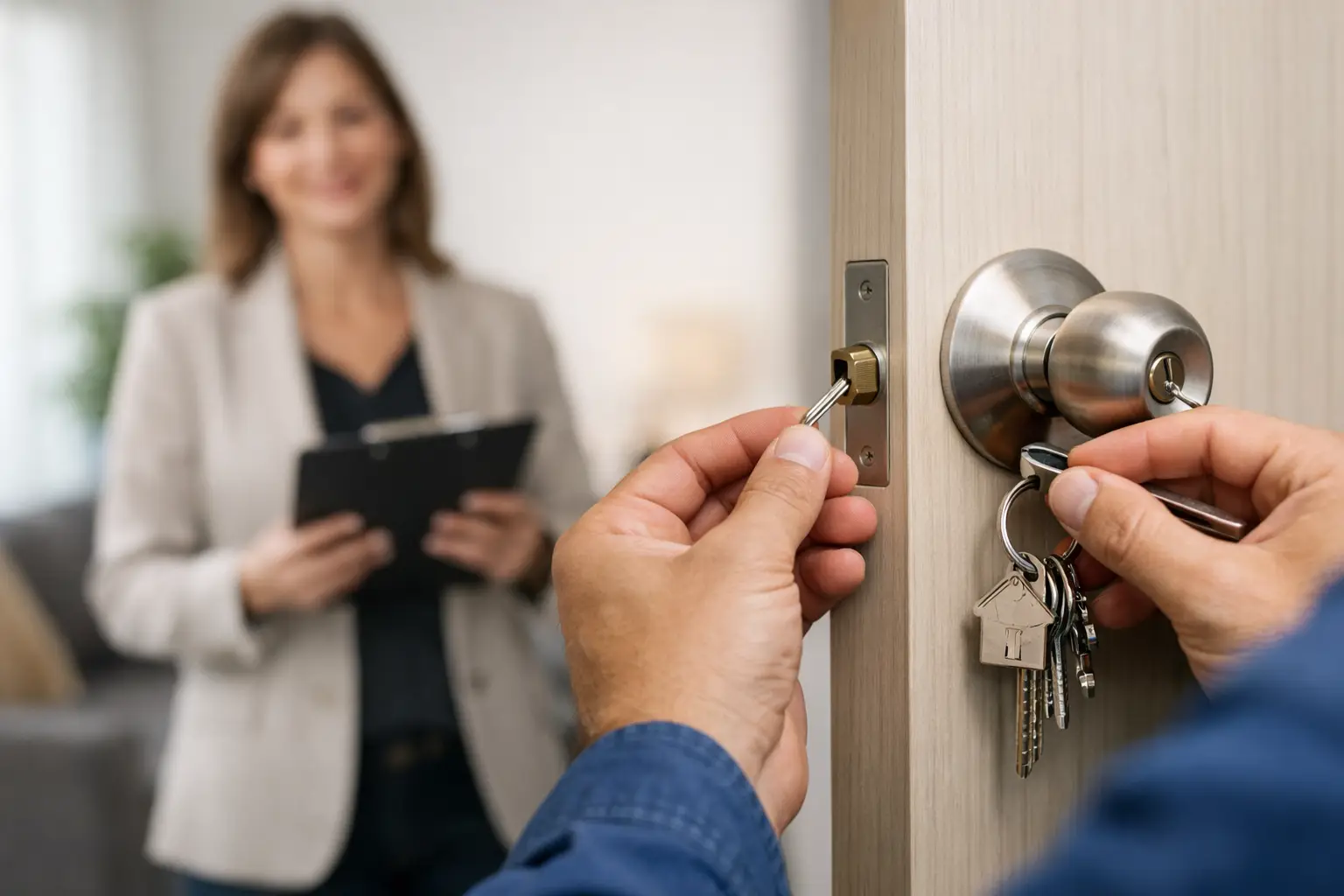
A unit turns over at 10:00 a.m. The cleaner is booked for noon. The new tenant gets keys at 4:00 p.m. If the locks are still on the old key, your schedule is already off track. That is why a property manager rekey turnaround example matters - not as a theory, but as a real timing benchmark for leasing, safety, and move-in coordination.
For property managers, rekeying is rarely just a locksmith task. It sits in the middle of turnover logistics, vendor access, maintenance timing, and liability. If one part slips, the whole handoff gets messy. The practical question is not just how long rekeying takes. It is how fast it can be done without missed windows, surprise charges, or keys that do not match the job order.
A realistic property manager rekey turnaround example
Here is a common scenario.
A tenant returns possession of a two-bedroom apartment at 9:30 a.m. The property manager confirms the move-out and wants the front door, back door, and mailbox rekeyed the same day. There is no damage to the locks, and the existing hardware is standard residential grade. The manager also wants four working keys and one temporary access key for vendors.
In a clean, organized job, the timeline can look like this: dispatch is confirmed within minutes, the technician arrives in a one- to two-hour service window, rekeys three cylinders on site in about 30 to 60 minutes, tests every lock, cuts the requested keys, and hands off or labels the new set before the next vendor enters. In plain terms, a straightforward same-day turnover rekey can often be completed in roughly two to three hours from call to finished handoff, depending on traffic, access, and lock condition.
That is the good version. The bad version starts when the unit is not actually vacant, the wrong lock count was given, the mailbox uses a different keyway, or someone asks for a lock change when a rekey was quoted. Those details change the turnaround fast.
What affects rekey turnaround time
The biggest factor is the difference between rekeying and replacing hardware. Rekeying keeps the existing lock and changes the internal pins so the old key stops working. If the lock is in decent shape, that is usually quicker and more cost-effective than swapping everything out. But if the hardware is worn, damaged, missing parts, or nonstandard, replacement may be the better call.
Access is the next issue. A locksmith can move fast, but not through a locked gate without entry instructions, a tenant who has not fully vacated, or a maintenance team blocking the door with paint supplies. Property managers who give clear gate codes, parking notes, lock counts, and contact info usually get faster results for a simple reason - the technician can start working the moment they arrive.
Keying goals matter too. If you want one unit rekeyed to a fresh key, that is one type of job. If you want that unit matched to a master key system, or keyed alike with another door on the property, the work takes more planning. It is still manageable, but it is not the same as a basic turnover call.
Then there is volume. One single-family rental can be quick. A four-unit same-day turnover with mixed hardware, restricted access, and a request for labeled key sets is a different operation. Not slow, but more involved.
The timing ranges property managers should actually expect
For a standard occupied-to-vacant turnover with common residential locks, same-day service is realistic when the schedule is handled early and the job details are accurate. On-site labor for one or two doors is often under an hour. Add travel, dispatch, key cutting, and coordination, and the total turnaround may land in the two- to four-hour range.
For small multifamily jobs, especially when multiple units need fresh keys after move-outs, a half-day window is often more realistic than a one-hour promise. That does not mean the locksmith is slow. It means good service includes verifying each cylinder, checking latch function, confirming copies, and avoiding mistakes that create callbacks later.
After-hours, weekends, and emergency requests can still be handled quickly, but they may not follow the same timing or pricing as a standard daytime turnover. A fair locksmith should say that up front. Speed matters, but not more than honest quoting.
Where delays usually come from
Most rekey delays are preventable.
The first problem is bad job intake. If the request says one lock and there are actually three keyed cylinders plus a security screen door, the schedule changes on arrival. The second problem is confusion about hardware type. Many property managers say rekey when they really mean replace, repair, or make one key work across multiple doors. Those are different jobs.
The third issue is handoff confusion. A rekey is not done when the cylinder is pinned. It is done when the right person has the right keys, the old keys no longer work, and access instructions are clear. If the technician finishes at 1:00 p.m. but no one knows where the keys went, your turnaround is not complete.
This is also where pricing disputes tend to start. Vague phone quotes often turn into inflated invoices later. A professional locksmith should ask enough questions to narrow the scope before arrival. If the situation changes on site, the update should happen before extra work starts, not after.
How property managers can shorten rekey time without cutting corners
If you manage enough turnovers, speed comes from process, not luck.
Start with a standard intake checklist. Give the lock count, property type, access instructions, contact person, and whether the job is basic rekeying, key matching, master key work, or hardware replacement. Mention if you need duplicate keys, vendor keys, or labeled sets. Those details save more time than any rush request.
It also helps to decide what your default policy is. Some managers rekey every turnover, no exceptions. Others only rekey after lost key incidents, evictions, domestic disputes, or uncertain key control. Either approach has trade-offs. Rekeying every time costs more up front but reduces risk and keeps the rule simple. Selective rekeying may save money, but it depends on reliable records and good judgment.
If you manage several units, consistency in hardware can make future service faster. Standard lock brands and compatible keyways are easier to rekey, easier to stock keys for, and easier to organize. Mixed hardware from years of piecemeal replacement tends to slow everything down.
When a fast rekey is the wrong move
Sometimes the fastest job is not the best job.
If the lock is sticking, loose, badly worn, or damaged after a forced entry, rekeying alone may leave you with a fresh key on failing hardware. That is not a win. In those cases, repair or replacement may protect the property better than a quick pin change.
There are also cases where access control needs have changed. If a small property is growing, adding staff, or cycling through vendors often, a basic rekey may solve today’s problem but not next month’s. A simple master key structure or a more deliberate key policy could save repeated service calls.
That is the part many people skip. Fast service should solve the actual problem, not just close the ticket.
What good locksmith communication looks like
Property managers do not need a speech. They need clean information.
A good service partner confirms the scope, gives a realistic arrival window, explains whether the work is rekeying or replacement, tells you how many keys are included, and flags any issue before it becomes a billing surprise. If the mailbox cannot be matched to the unit key, say it early. If the lock is not rekeyable, say it early. If the job can be finished same day, say that clearly and then do it.
That straightforward approach is the whole point. It is one reason many managers across San Diego keep a go-to local locksmith on file instead of gambling on the lowest phone quote.
At Fast & Fair Locksmith, that is the standard we believe property managers should expect - quick dispatch, clear scope, and pricing that stays fair when the work starts.
The benchmark that actually matters
A useful property manager rekey turnaround example is not just a number of minutes. It is a chain of events that ends with secure access, working keys, and no confusion about who can enter the unit next.
If your locksmith can consistently take a standard turnover from service request to completed key handoff within a few hours, with clear pricing and no drama, that is not extra. That is the baseline. And when the job is more complicated, the real value is hearing the truth early, so your schedule can adjust before your move-in does.
The best rekey turnaround is the one that keeps your property secure and your day moving without leaving you to clean up someone else’s shortcuts.