
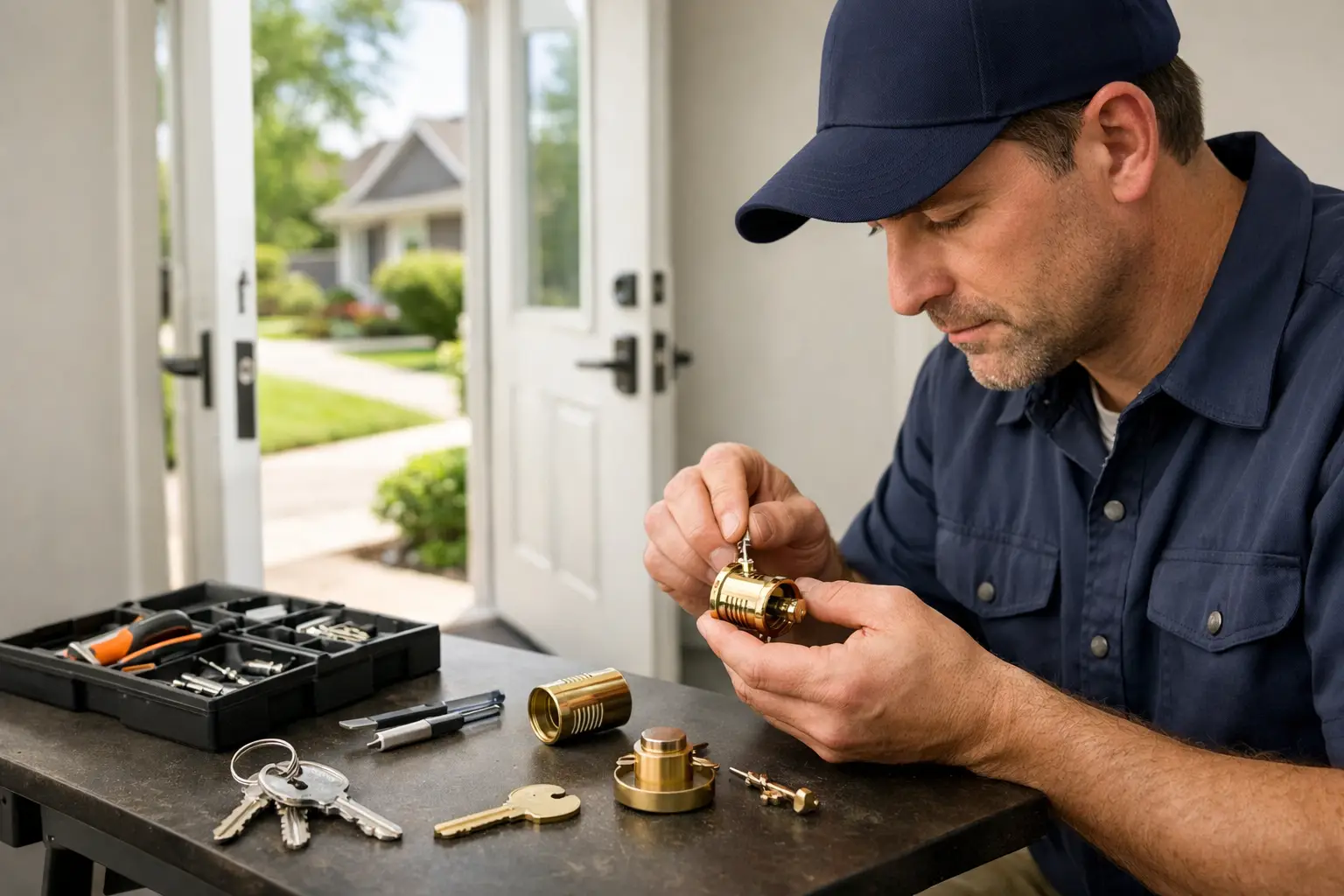
You usually ask how to rekey house locks right after something changes. You moved in. A tenant moved out. A contractor still has a key. A roommate situation went sideways. The good news is rekeying is often faster and cheaper than replacing the whole lock. The bad news is a lot of people start the job before they know what kind of lock they actually have.
Rekeying means changing the inside of a lock so the old key stops working and a new key works instead. You keep the existing hardware if the lock is in good shape. That makes rekeying a smart move when your goal is access control, not a cosmetic upgrade.
For most homeowners, this comes down to one question: should you do it yourself or call a locksmith? The honest answer is it depends on the lock, your tools, and how much room you have for error. If you have standard pin tumbler locks and the right rekey kit, a DIY job may be realistic. If the locks are worn, mismatched, high-security, smart-lock compatible, or part of a larger property setup, professional service usually saves time and headaches.
What rekeying changes and what it doesn’t
A rekey changes the pins inside the cylinder so a different key pattern is required. It does not repair a damaged lock, fix a sagging door, or improve a weak deadbolt. If your lock sticks, your strike plate is misaligned, or the hardware feels loose, rekeying alone will not solve that.
That matters because people often mix up three different services: rekeying, replacing, and repairing. Rekeying is usually the best value when the lock body still works fine. Replacement makes more sense if the hardware is cheap, failing, outdated, or you want a different finish or style. Repair is the right move when the problem is mechanical wear, not who has the key.
When rekeying makes the most sense
If you just moved into a home, rekeying should be near the top of your list. You do not know how many copies of the old key exist or who still has one. The same applies after a breakup, staff turnover, a lost key, or tenant changeover.
Rekeying is also useful if you want one key to work on multiple doors. In many cases, a locksmith can key several compatible locks alike so your front door, back door, and side door all use one house key. That is convenient, but only if the locks are compatible by brand and keyway. Not every lock can be made to match.
How to rekey house locks yourself
If you want to try it, start by checking the brand of your lock. Most DIY rekey kits are brand-specific. A Kwikset kit usually will not work on a Schlage lock, and neither will help with every off-brand deadbolt from a big-box store. You need the right kit, the current working key, a plug follower if the kit requires one, and a clean place to work where tiny pins will not vanish.
Step 1: Remove the lock cylinder
Take the lock off the door and access the cylinder. The exact process depends on whether you are working on a knob, lever, or deadbolt. Keep screws organized. If parts come off in a rush, reassembly gets messy fast.
Step 2: Use the current key to turn the plug
Insert the existing key and rotate the plug as directed by the kit. This is what allows the cylinder plug to come out without dumping pins and springs everywhere. If you do not have the current key, DIY rekeying gets much harder and often stops right here.
Step 3: Replace the old pins with new pins matched to the new key
This is the core of the job. The new key determines which pin sizes go into each chamber. Most kits include a chart or gauge. If even one pin is wrong, the key may stick, bind, or fail completely.
Step 4: Reassemble and test before reinstalling
Test the new key several times while the lock is still off the door. Then test it again after reinstalling. Make sure the key inserts fully, turns smoothly, and returns properly. If the lock works off the door but binds on the door, you may have an alignment issue rather than a rekey issue.
Where DIY goes wrong
The most common mistake is using the wrong rekey kit. The second is losing pins or mixing them up. The third is assuming every lock can be rekeyed the same way. That is not how it works.
Some locks are easy and forgiving. Others are not. Older locks may have wear that makes fresh pins behave inconsistently. Lower-quality hardware can feel rough even when pinned correctly. Smart lock systems may still use a standard cylinder, but some have brand-specific parts or restrictions. If you force anything, you can turn a simple rekey into a lock replacement.
There is also the question of time. A first-time DIY rekey can eat up an afternoon, especially if you are trying to key multiple doors alike. If your goal is getting the house secured today, that trade-off matters.
How to rekey house locks when you need it done fast
If speed matters, this is where a locksmith earns the call. A trained technician can usually identify the lock type, confirm whether it is worth rekeying, and complete the work on-site without trial and error. That is especially useful when you have several doors, mixed hardware, or a missing key.
A locksmith can also spot problems that a kit cannot fix. If the deadbolt is worn out, the latch is failing, or the door frame is part of the problem, you want to know before paying for the wrong service. Fair service means doing the job that solves the problem, not just the job that sounds cheapest upfront.
This is also where pricing transparency matters. Rekeying is usually less expensive than full replacement, but the final cost depends on how many cylinders need service, whether the locks are standard residential hardware, and whether any lock is damaged or incompatible. Honest pricing should be clear before the work starts.
When you should skip rekeying and replace the lock
Rekeying is not always the right call. If the lock is loose, corroded, cracked, or hard to turn even with the correct key, replacement may be the better use of money. The same goes for doors that need better security than the current hardware can offer.
If you recently had a break-in or attempted forced entry, inspect the whole setup. A fresh key pattern does not fix bent hardware, a weak strike plate, or a doorjamb that took damage. Security is only as strong as the weakest part of the opening.
You may also want replacement if you are trying to standardize hardware across a property. Property managers run into this often. Rekeying several incompatible locks can become more trouble than replacing them with a matching set that can be keyed alike from the start.
Special cases that change the answer
Renters should check the lease before changing anything. Some landlords require written approval, and some want a copy of the new key. If you are a property owner, local rules and lease terms still matter when rekeying after a tenant turnover.
For short-term rentals, rekeying can be part of a broader access plan, but it may not be the whole solution. If multiple cleaners, vendors, or guests need controlled entry, key management matters as much as the lock itself.
For older homes, expect surprises. Decades-old hardware may be rekeyable, but parts availability can be inconsistent. In those cases, the cheapest-looking route at the start is not always the least expensive by the end.
A practical way to decide
If you have one or two standard locks, the current working key, the correct brand-specific kit, and patience for small parts, DIY may be worth trying. If you need several locks keyed alike, do not have the key, are dealing with worn hardware, or simply need the job handled today, professional rekeying is usually the smarter move.
That is especially true when you are protecting a home after a move, a lost key, or a security concern. Fast matters. Fair pricing matters too. You should not have to guess what the job involves or get pushed into replacing hardware that still has life left in it.
In the San Diego area, that balance matters even more when life is moving fast and you need the house secured without wasting half a day. Rekeying is one of those jobs that should feel simple when it is done right. If it starts turning into a puzzle, that is your sign to stop, protect the lock, and get it handled before a small problem becomes an expensive one.