
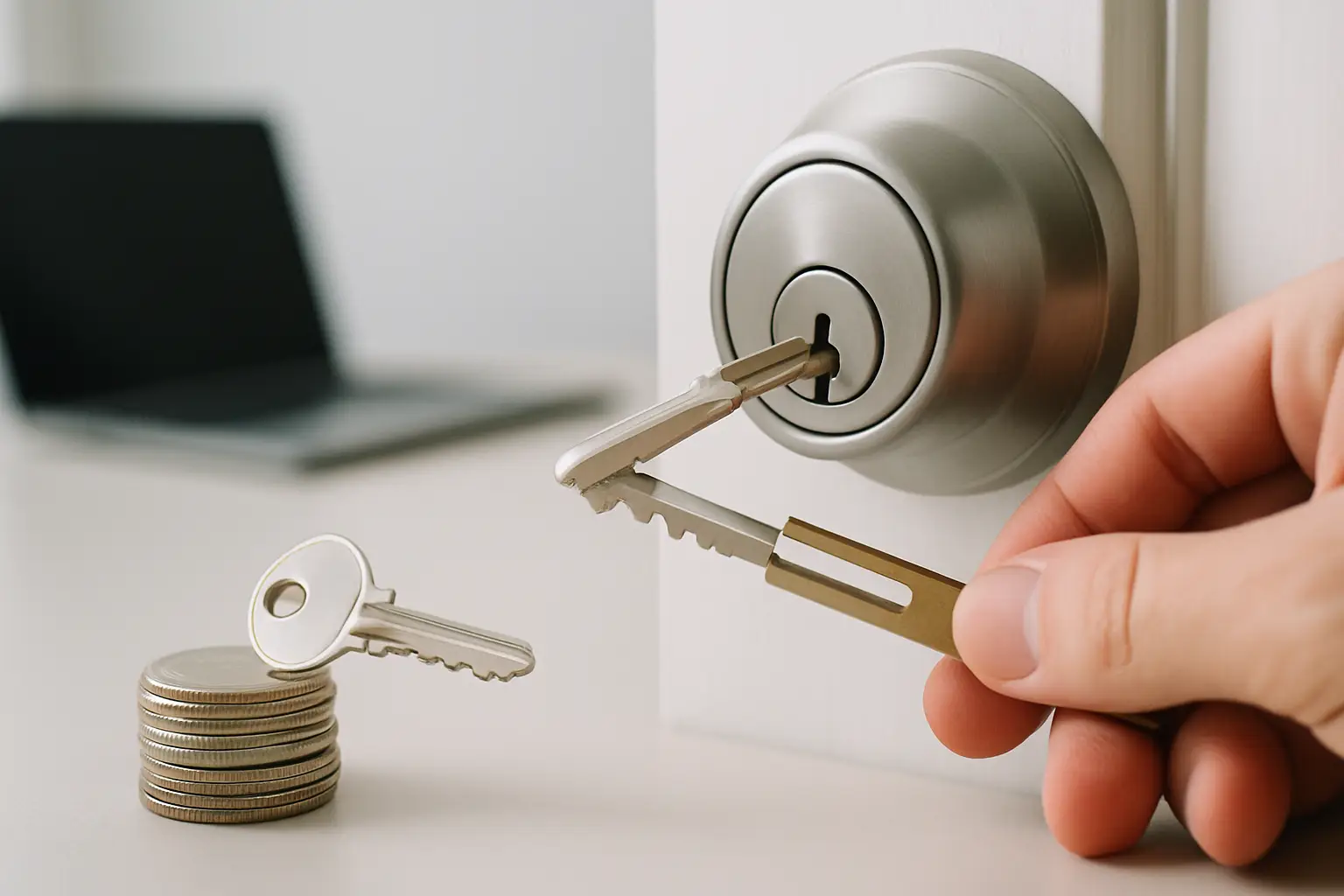
You shut the door and realize the key that used to work suddenly does not. Or you just handed keys to a contractor, a roommate moved out, or a tenant turned in a set that looks a little too “copied.” The fastest way to feel in control again is usually rekeying, not replacing every lock.
So how much does rekeying cost? The honest answer is: it depends on the lock, the count, and the conditions at the door. The useful answer is: you can predict the range pretty accurately if you know what actually moves the price.
How much does rekeying cost, typically?
For most homes and small businesses, rekeying is priced per lock (or per cylinder) plus a service call/trip charge in many cases. In the real world, you will see these rough ranges most often:
A straightforward, standard pin-tumbler lock rekey commonly lands around $15 to $40 per cylinder when it is part of a larger job. If you are only rekeying one lock, the per-lock price might look higher because the tech still has to drive out, diagnose the hardware, and do the work on-site.
Service call fees vary a lot by company and time of day. During normal hours, many legitimate locksmiths charge something like $50 to $120 to come out, then the labor per lock on top. After-hours, weekends, or true emergencies can raise the total.
If you are rekeying a typical house with multiple doors, the math often works in your favor. Four to six cylinders rekeyed in one visit is where people usually feel the “why didn’t I do this sooner” relief.
Rekey vs. replace: the cost difference that matters
Rekeying changes the internal pins so your old keys stop working and a new key works instead. Your existing lock hardware stays on the door. Replacing means new hardware, new finish, and sometimes new holes or alignment issues.
If your locks are in decent shape, rekeying is almost always the lower-cost move. Replacement starts stacking costs fast: new locksets, new deadbolts, extra labor if the door is misaligned, and sometimes the surprise of “this lock doesn’t fit that prep.” Rekeying is the cleaner fix when the goal is simply to control who can get in.
There are times replacement is the smarter spend: if the lock is worn out, sticky, damaged from a break-in attempt, or you want a security upgrade (like bump-resistant cylinders or higher-grade commercial hardware). But if the lock works fine today and you just want key control, rekeying is usually the fair play.
What actually drives rekeying price
People get burned in the locksmith world because pricing is sometimes vague on purpose. Here is what legitimately changes the quote.
Number of cylinders, not just “locks”
A “lock” can mean a lot of things. A front door might have a deadbolt and a knob - that is two cylinders to rekey if both use a key. A business door might have a mortise cylinder plus a separate deadbolt. A double-cylinder deadbolt has two keyed sides - that is also two cylinders.
If you want accurate pricing, count cylinders. Tell the locksmith: “Front door has a deadbolt and keyed knob, back door has a deadbolt only,” and you will get a much cleaner estimate.
Lock type and keyway
Basic residential locks are usually quick. High-security cylinders and restricted keyways can require special parts, special keys, and extra time. Some locks are designed to be rekeyed easily; others are a pain. That affects labor.
Also, not every “smart lock” is a rekey. Some have a physical key cylinder that can be rekeyed; some do not. If you have keypad or smart hardware, the right move might be changing codes, resetting access, or replacing a module - different job, different price.
Keying goals: one key or multiple keys
Most customers want everything keyed alike so one key works on every door. That can be simple, but it depends on whether your existing hardware can share the same keyway.
If you want a master key system (common for property managers and small businesses), that is more planning and pinning time. It can be completely worth it, but it is not the same cost as “make these two deadbolts match.”
Condition of the hardware
Rekeying assumes the cylinder can be taken apart and rebuilt. If the lock is corroded, seized, or has broken components, the tech may have to service it, replace parts, or recommend replacement. That is not an upsell if the lock literally cannot be rekeyed reliably.
A good locksmith will show you what is wrong and give you options: fix and rekey, replace the cylinder only, or replace the whole lockset.
Time and access
If your door is easy to work on, the job is faster. If it is a commercial door with a complicated lockset, a security door, or a door that is misaligned and fighting the latch, it takes longer.
After-hours service also costs more because you are paying for urgency. If you are locked out at 11:30 p.m., the price is not the same as a scheduled rekey at 10:00 a.m.
Common pricing scenarios (real-life examples)
Here is how the cost typically plays out in everyday situations.
A renter rekeys one deadbolt after moving in. Because it is a single-cylinder job, the service call is a bigger chunk of the total. Expect a bill that often lands in the low hundreds depending on timing.
A homeowner rekeys three exterior doors with a deadbolt on each, all keyed alike. That is three cylinders (or six if each door has a keyed knob too). Because the tech is already on-site and doing multiple cylinders, your per-cylinder cost is usually lower and the total feels more reasonable.
A small business rekeys a storefront door plus a back door and wants a master key for the manager. The planning and pinning take longer than a simple rekey, but it solves a real operational problem: you can hand employees a key that opens only what they should access.
A property manager rekeys multiple units in one visit. This is where organization matters. If you have clear unit access, correct hardware, and a consistent key system, the job becomes efficient and the pricing tends to be fairer across the batch.
How to avoid surprise fees (and spot bad quotes)
If you remember one thing about locksmith pricing, remember this: anyone can quote a low number on the phone. The bill is where honesty shows up.
A fair rekey quote should include the service call (if any), the per-cylinder cost, and whether keys are included. It should also be clear about after-hours pricing before the technician is dispatched.
Be cautious when you hear extremely low quotes with no details. The bait-and-switch pattern is common: a low “starting at” number, then “your lock is high-security” or “this is a special cylinder” as soon as the tech arrives. Sometimes that is true. Often it is a script.
Ask direct questions:
- “What is your service call fee during normal hours, and what is it after-hours?”
- “What is your price per cylinder to rekey standard residential locks?”
- “How many new keys are included?”
- “If a lock cannot be rekeyed, what are my options and price ranges?”
If the answers are evasive, you are taking a gamble.
Rekeying cost vs. the cost of not rekeying
Rekeying is one of those boring purchases that saves you from expensive problems. If you lost a key, if keys were copied, or if you just cannot account for who has access, the “cheap” option is doing nothing - until it is not.
The cost of an unauthorized entry is not just stolen items. It is the feeling that your home or business is exposed, the time dealing with insurance or reports, and the disruption of replacing things you did not plan to replace. Rekeying is preventative spending with a clear outcome: old keys stop working.
When rekeying might not be the right call
Sometimes the best advice is: do not rekey this.
If the lock is a low-end builder-grade model that is already failing, it might be better to replace it now rather than pay to rekey something you will throw away soon.
If you are upgrading security, rekeying does not change the strength of the bolt, the strike plate, or the door frame. A rekey fixes key control, not door reinforcement.
If you have a break-in attempt and the lock was drilled, forced, or damaged, rekeying may not restore safe operation. In that case, a locksmith should recommend replacement or at least replacing the cylinder.
Scheduling tips that keep the bill down
If you are not locked out, schedule it. Planned rekeys during normal business hours are usually the best value.
Also, do a quick count before you call. Walk the property and note which doors are keyed, and whether there is a deadbolt, a keyed knob, or both. If you want everything on one key, mention that up front.
Finally, gather any existing keys you want to keep using. Some customers want the new key to match an existing key they already like. Depending on the lock brand and keyway, that may be possible, or the locksmith may recommend a fresh key system for consistency.
Rekeying in San Diego: what locals should expect
In busy areas like San Diego, pricing swings are often about timing and travel. Same lock, same hardware - a scheduled daytime visit is typically much cheaper than a late-night emergency. If you are managing multiple doors (home, rental, small business), bundling them into one visit is usually the cleanest way to keep costs fair.
If you want a straight answer from a dispatch-style team that focuses on fast arrival and transparent pricing, you can contact FAST & FAIR LOCKSMITH for an on-site rekey.
A final thought
Rekeying is not about fancy hardware. It is about control. When you price it out, focus less on the cheapest number you can find and more on a clear, itemized expectation - how many cylinders, what is included, and what changes after-hours. That is how you stay safe and keep the cost fair.