
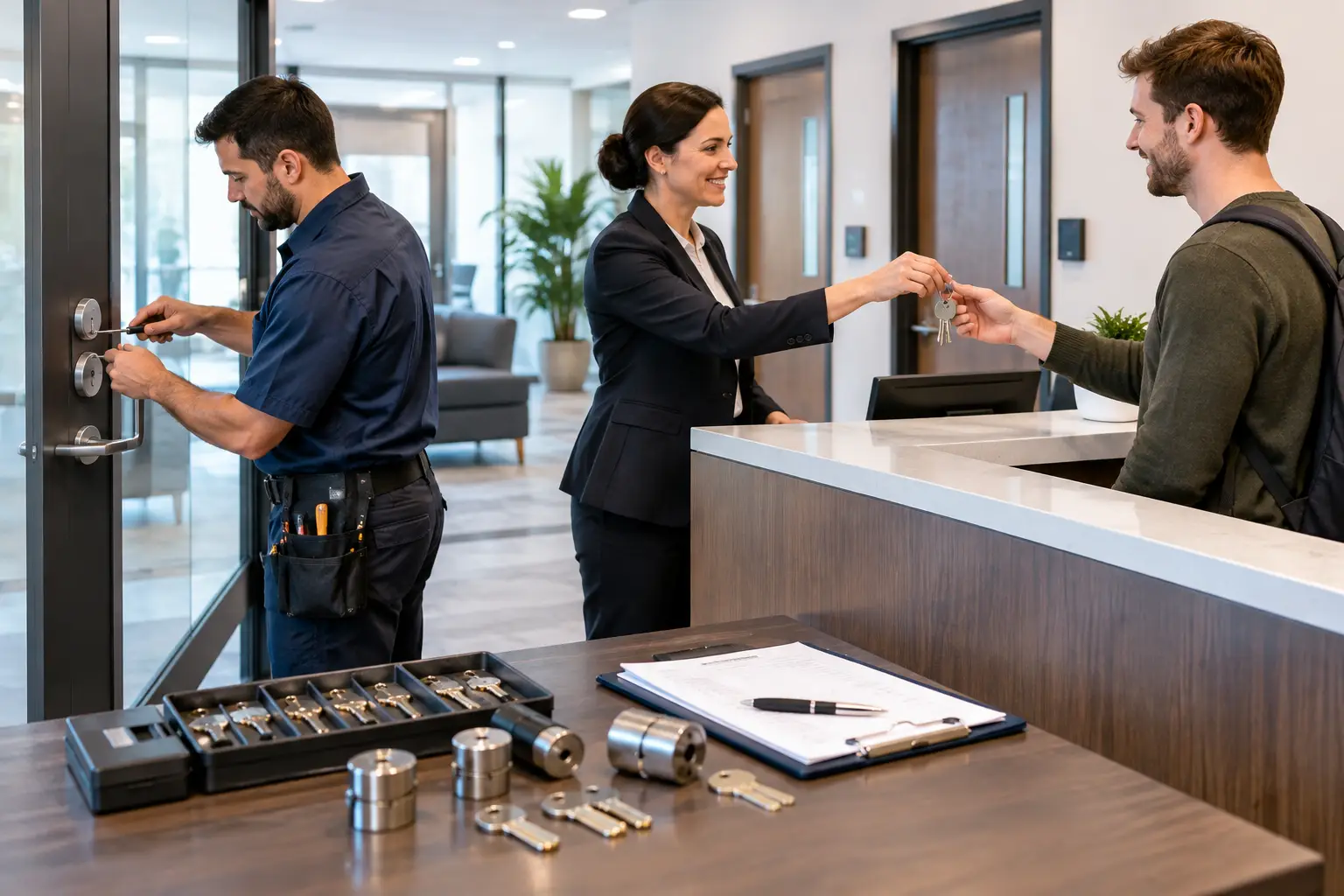
A former employee still has a key. A shared office tenant moved out without returning theirs. Or your storefront key disappeared somewhere between the parking lot and home. Those are not small inconveniences. They are access-control problems. This guide to commercial rekeying for tenants explains what you can do quickly, what requires landlord approval, and how to avoid paying for work that does not solve the real issue.
What Commercial Rekeying Actually Does
Rekeying changes the internal pins inside an existing lock cylinder so the old key no longer works. The lock hardware stays in place, but it operates with a new key. For many commercial doors, that is faster and less expensive than replacing the full lockset.
A rekey is often the right call when the door and lock are in good shape but control of the keys is not. It can immediately cut off access from a former employee, vendor, roommate in a live-work unit, or anyone else who should no longer enter your space.
Replacing the entire lock is different. That may be necessary when the hardware is damaged, outdated, incompatible with a new access system, or not meeting the building’s fire or security requirements. A fair locksmith should explain which job is needed and why. If rekeying will do the job, you should not be pushed into an unnecessary replacement.
First Question: Can a Tenant Authorize a Rekey?
It depends on your lease and on the door involved. A tenant may have authority over locks that serve only their leased suite, but many commercial leases require written approval before changing keys or lock hardware. The property owner or manager may also need to receive a copy of the new key.
Doors that lead to common areas, building corridors, shared restrooms, exterior entries, loading zones, and utility rooms are usually not yours to rekey on your own. These may be tied into a master-key system or subject to building-wide access policies.
Before scheduling service, read the lock and access section of your lease. If the language is unclear, contact your property manager. This one call can prevent a conflict, a duplicate service charge, or a lock change that has to be undone later.
If there is an urgent security issue, such as a terminated worker with an active key or a break-in, tell the manager that directly. Most will understand the need to secure the premises quickly. Ask for approval by text or email when possible, so everyone has a record of the authorization.
Have These Details Ready
A locksmith can work faster when you can provide the basics: the suite address, the door or doors involved, whether the lock is exterior or interior, and whether you have a current working key. It also helps to know who is authorized to approve the work.
For larger buildings, ask whether the lock is part of a restricted or master-key system. A standard locksmith may be able to rekey the cylinder, but changing a master-keyed lock without coordinating with building management can disrupt the system. That is a costly mistake nobody needs.
When Tenants Should Rekey Right Away
Some situations should not wait until next week. Rekey promptly after an employee leaves under difficult circumstances, a key is lost with identifying information, a contractor does not return keys, or your key ring is stolen.
The risk is higher for businesses with cash drawers, client files, inventory, tools, medication, electronics, or after-hours staff. A missing key does not prove someone will use it, but it does mean you no longer control access. Rekeying restores that control.
For an ordinary lost key with no address or business identification attached, the urgency may be lower. Still, consider how easy it would be for someone to connect the key to your location. A key lost inside a large shopping center is a different risk than one dropped beside your marked company vehicle.
If the door was forced, the priority changes. The frame, latch, strike plate, closer, and hardware may need inspection before a rekey. Rekeying a lock on a damaged door without addressing the damage can leave the space vulnerable.
Rekeying a Commercial Space Without Creating New Problems
The goal is not simply to make a new key. The goal is to leave your business with clear, controlled access. Start by deciding who needs a key and who does not. Be specific. Owners, managers, opening staff, closing staff, cleaning vendors, and maintenance teams may all have different needs.
Avoid making unlimited copies “just in case.” Extra keys tend to become untracked keys. Keep a simple key log with the name of the person who received each key, the date, and the key number if one is stamped on it. When someone leaves, collect the key immediately and document its return.
For a small office or storefront, a single keyway may be enough. For a business with several rooms, you may want one key for management and separate keys for staff areas. This is where a locksmith can help you think through the setup before work begins. More complicated systems offer better control, but they also cost more and require better recordkeeping.
Do not forget secondary access points. A front door may be rekeyed while a rear door, storage room, side gate, mailbox, or file cabinet still uses an old key. Walk the premises and identify every lock connected to your security concern.
Commercial Rekeying Costs: What a Fair Quote Should Cover
Pricing depends on the number and type of locks, the key system, the condition of the hardware, the time of service, and whether the technician must travel after hours. A commercial-grade cylinder or a restricted key system can cost more than a basic office lock, and that is reasonable when specialized parts or authorization are involved.
What is not reasonable is a vague low quote that turns into a much larger bill after the technician arrives. Before work begins, ask for the service-call charge, the labor charge, the cost per cylinder, the price of additional keys, and any after-hours fee. Ask whether the quoted price includes the new keys and whether there could be charges for damaged or specialty hardware.
A trustworthy technician will inspect the lock, explain the options, and give you the total before proceeding whenever the scope is known. If new information changes the job, such as a damaged cylinder or a master-key restriction, you should be told before added work begins.
Fast & Fair Locksmith approaches commercial service the way it should be handled: show up ready to work, explain the job in plain language, and keep the price clear.
A Guide to Commercial Rekeying for Tenants With Master Keys
Master-key systems deserve extra care. In these systems, one key may open several doors while other keys open only specific doors. They are common in office buildings, medical suites, retail centers, and multi-tenant properties.
If your suite lock is part of that system, an independent rekey could stop your suite key from working correctly with the building’s master key. It could also create an unauthorized key path. The right process may require the property manager, the system records, or an approved locksmith.
That does not mean you must accept a security risk while waiting. Tell management exactly why access needs to change. They may authorize an immediate system-compliant rekey, issue temporary controls, or arrange service through their preferred provider. Get the expected timing and responsibility for costs in writing.
After the Rekey: Test and Document
Before the technician leaves, test every new key in every lock it is supposed to operate. Make sure the latch engages fully, the door closes properly, and the key does not stick or require force. A key that works only when the door is held in a certain position may point to a door alignment problem, not a key problem.
Keep the invoice, note the date of service, and update your key log. If your landlord requires a key copy, deliver it according to the lease rather than handing over your only working key. Request enough copies for authorized staff and keep one secured backup under management control.
A commercial rekey is a practical reset. Handle it with the right approval, a clear price, and a plan for every key that leaves your hands. That turns a stressful access problem into a secure, documented fix you can move past quickly.