
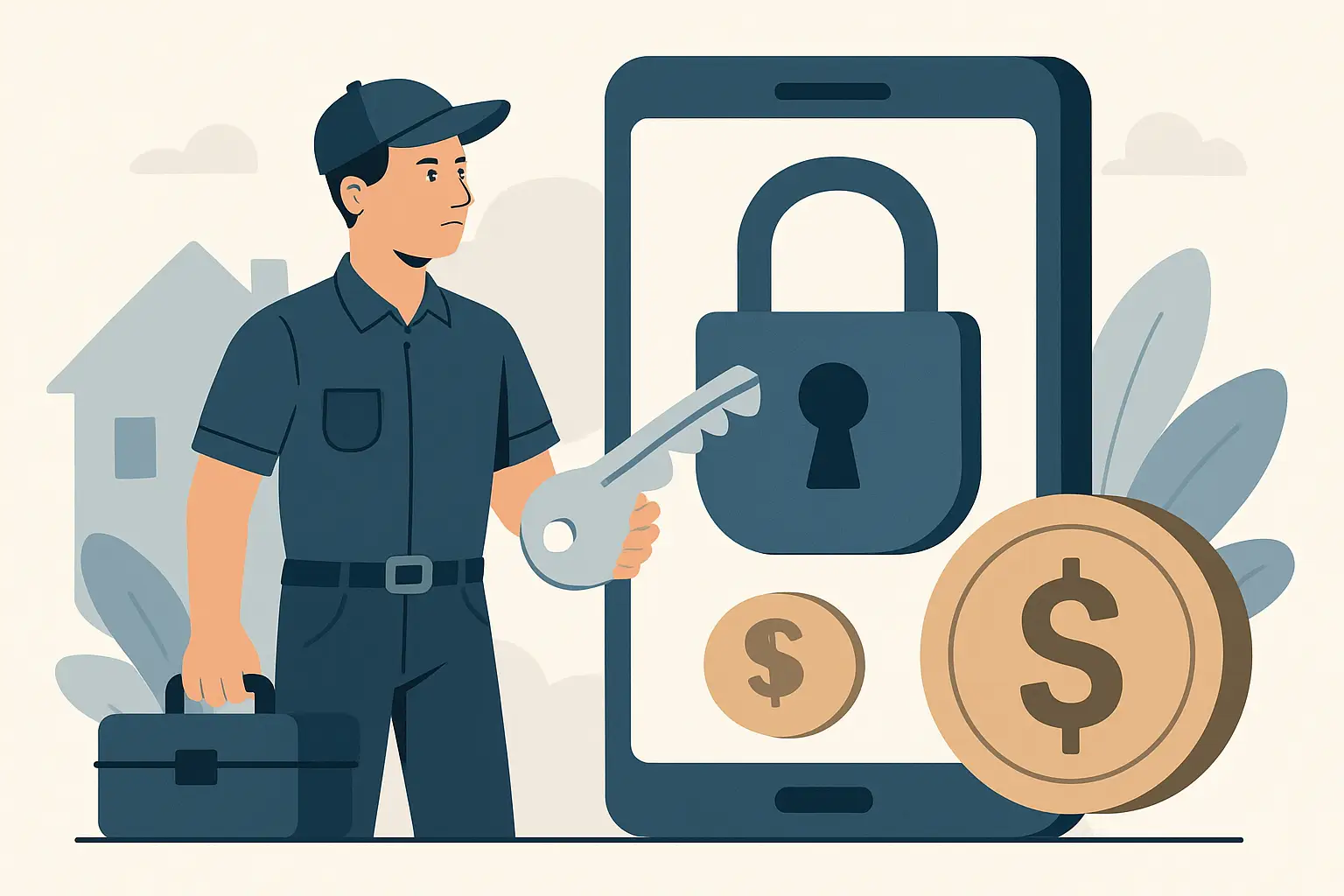
You’re standing outside. Phone in one hand, keys nowhere. The only thing you want is a real number and a fast arrival - not a mystery quote that doubles when the tech shows up.
That’s exactly what this article is for: a clear, practical emergency locksmith price estimate, plus the few details that actually move the price up or down. Because in an emergency, “it depends” isn’t helpful unless someone tells you what it depends on.
Emergency locksmith price estimate: real-world ranges
Most emergency calls fall into a few common buckets. The ranges below are broad on purpose because the U.S. has big differences in labor rates, travel distances, and local demand. Still, these numbers are a solid reality check if you’re trying to spot an inflated quote.
For a basic residential lockout (unlocked door, standard knob or deadbolt, no drilling), many people land somewhere around $100-$250. If it’s after-hours, a weekend, or a holiday, that same call often climbs into the $150-$350 range.
Car lockouts (keys locked inside, door can be opened with proper tools) frequently come in around $100-$300, with after-hours pushing higher. If you’re dealing with a car key problem instead of a lockout - like a broken fob, no spare, or a key that needs programming - you’re usually in a different price category entirely.
Commercial lockouts vary more, mostly because hardware varies more. A simple office door might look like a house call. A storefront with a higher-security cylinder, restricted keyway, or multiple locks can raise labor time and cost.
The important line in the sand: if someone quotes you an unbelievably low number over the phone without asking any questions, you should assume it’s not the real total. Emergency locksmith pricing should be fast and clear, but it still has to be based on basic facts.
What actually drives the price up or down
Locksmith pricing is mostly about time, difficulty, and risk. Not “how desperate you sound.” Here are the factors that legitimately change an emergency estimate.
Time of day and urgency
After-hours service is a real cost. A technician is leaving home, rerouting their schedule, or working overnight. That’s why nights, weekends, and holidays usually add a premium.
“Right now” also matters. If you’re requesting the next available technician, the price is often lower than demanding an immediate dispatch that pulls a tech off another job.
Distance and travel
Travel charges are common, and they should be disclosed upfront. A fair company will tell you the service area and whether mileage is included.
If you’re on the edge of town, in a rural area, or stranded off a highway exit, travel time can be a meaningful part of the bill.
Type of door and lock
Not all lockouts are the same. A basic doorknob is typically quicker than a high-security deadbolt. A door with tight tolerances, a misaligned strike plate, or swelling from weather can add time.
And if you’re locked out because the lock is damaged or the key broke inside, that’s no longer “just” a lockout. Extraction, repair, or replacement changes the scope.
Drilling and replacement (the big price swing)
Most clean lockouts don’t require drilling. But if the lock is failed, damaged, or extremely resistant to non-destructive entry, drilling might be necessary.
Drilling almost always means replacement, and replacement adds parts cost. That’s one of the biggest reasons an estimate can jump from “reasonable” to “wait, what?”
A fair locksmith explains the fork in the road before it happens: the price for attempting non-destructive entry, and the price if the lock must be drilled and replaced.
Car key programming vs a car lockout
If your keys are inside the car, you’re usually paying for entry. If you lost your only key, you’re paying for creation.
Key creation can include cutting a mechanical key, programming a transponder chip, pairing a key fob, or all of the above. Vehicle make, model, and year matter a lot here. Some cars are straightforward; others require more time, more steps, and more expensive key blanks.
Complexity: multi-point locks, smart locks, and specialty hardware
Multi-point locks and some smart lock setups can be quick with the right approach, but they can also be time-consuming when something fails.
If a smart lock is dead, the question becomes: are you locked out because the lock is out of power, because the mechanism is jammed, or because the door alignment is off? The fix changes the time.
Specialty commercial hardware, panic bars, and restricted cylinders often require more skill and sometimes more parts. That’s legitimate - but it should be explained.
How to ask for a real estimate in under 60 seconds
The fastest way to get a usable estimate is to give the dispatcher the information that affects labor time and parts. You don’t need to know lock jargon. You just need to answer a few basic questions.
Tell them whether it’s a house, apartment, business, or vehicle. Confirm whether the door is simply locked or if a key broke, the lock is jammed, or the handle is loose. If it’s a car, share the year, make, and model and whether the keys are inside or missing.
Then ask two direct questions:
First: “What’s the total price range for this job, including service call, labor, and after-hours fees?”
Second: “What would make the price go higher once the technician arrives?”
A fair company won’t pretend they can predict every edge case, but they can tell you the normal range and the conditions that change it.
Fees that are normal - and fees that are a red flag
Some line items are normal in emergency service. The problem is when they’re hidden until the end.
A standard service call or trip fee is common. After-hours fees are common. Parts are parts.
The red flags are the vague charges that only appear once you’re under pressure: “security fee,” “special tool fee,” “lockout surcharge,” or “mandatory replacement” without a clear reason.
Another red flag is the bait-and-switch pattern: a very low quote on the phone, then an on-site price that’s two to five times higher, justified by something dramatic like “high-security lock” when you’re looking at a normal residential deadbolt.
You’re allowed to pause the job. You’re allowed to ask for the price before work starts. And you’re allowed to decline if the number changes without a clear explanation.
What you can do right now to keep the price fair
If you’re calling while stressed, you’re easier to rush. Slow it down for ten seconds and protect yourself.
Ask for the total estimate, not “starting at.” Ask if drilling is expected and what it would cost if it becomes necessary. Ask if the technician is paid commission on upsells. Not every company will answer that cleanly, but how they react tells you a lot.
If you’re locked out of a home, check whether any other entry point is already open and safe to use, like a garage side door or a back door you can access without trespassing. Don’t break a window unless you’ve decided it’s worth it. Glass repair usually costs more than a locksmith.
If you’re in an apartment, consider calling property management if it’s daytime. Some buildings have on-call maintenance with set pricing. The trade-off is speed.
If it’s a car lockout, confirm your exact location and make sure the vehicle is in a safe spot for a technician to work. Time lost finding you or relocating the car can add cost.
Why “cheap” is often the most expensive option
Emergency pricing should be fair, but it should also be believable. A rock-bottom quote can be a setup for one of two outcomes.
One outcome is the price jump after arrival. The other is careless work: scratched doors, bent frames, damaged weatherstripping, or drilled locks that didn’t need drilling.
The trade-off is simple. You want a locksmith who can show up fast and fix the problem without creating a new one. That usually costs more than the lowest number a stranger is willing to say on the phone.
A quick scenario check: what would your call likely cost?
If you’re locked out of a standard home door at 2 p.m. and nothing is broken, you’re usually in the lower end of the ranges.
If it’s 11 p.m., raining, and the deadbolt is jammed, expect the higher end because the job might shift from entry to repair.
If you lost your only car key for a newer vehicle, you’re not paying for “getting in.” You’re paying for getting a working key in your hand. That’s where estimates can climb, and it’s also where clear, ethical pricing matters most.
Fair pricing is a promise, not a vibe
If you want fast help without pricing games, call a company that will give a real range, explain what changes it, and get approval before doing anything that increases the bill. That’s the whole point of being both fast and fair.
If you’re in our service area, you can reach FAST & FAIR LOCKSMITH at https://Fastandfairlocksmith.com for straightforward dispatch and pricing that doesn’t shift just because you’re in a bind.
The best emergency plan is still simple: get a clear estimate, get the technician en route, and stay in control of the decision points. When the door opens, you should feel relief - not regret.