
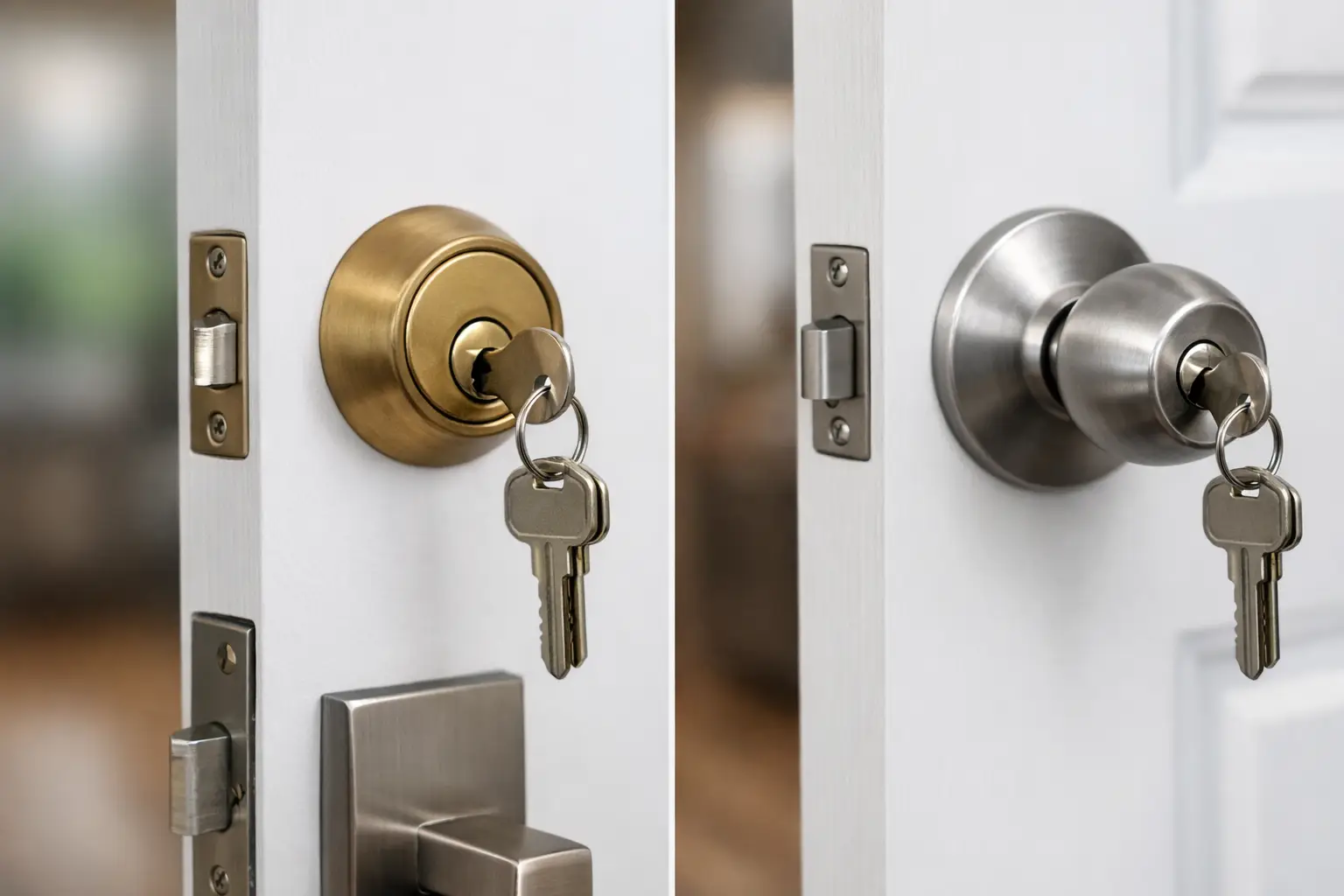
A locked doorknob can make a front door feel secure right up until someone leans on it, kicks it, or uses the wrong kind of force. That is the real issue behind deadbolt versus knob locks: they do different jobs, and treating them as equal can leave a home, rental, or storefront easier to breach than it needs to be.
For most exterior doors, the practical answer is not choosing one or the other. It is using a properly installed deadbolt as the main security lock and a knob or lever lock for everyday latching and convenience. The details matter, though. Door material, frame condition, who uses the door, and emergency exit requirements can all change the right recommendation.
Deadbolt Versus Knob Locks: The Core Difference
A knob lock has a spring-loaded latch. Turn the knob or lever, and the latch pulls back into the door. When the door closes, the latch springs into the strike plate in the frame. That makes it convenient for bedrooms, bathrooms, interior offices, and doors that need to stay shut without being secured like an exterior entry.
A deadbolt uses a solid metal bolt that extends into the door frame when locked. It does not rely on a spring latch, so it is far more resistant to pushing, prying, or force against the door. A standard single-cylinder deadbolt is operated with a key from outside and a thumb turn from inside.
That basic design difference is why a knob lock alone is usually not enough for an exterior residential door. The locking button on a knob can deter casual entry, but the latch and lock body were not designed to carry the same force as a quality deadbolt.
There is one major qualifier: a deadbolt only works as well as the door, frame, strike plate, and screws supporting it. A strong deadbolt installed in a weak, split jamb is not a complete security upgrade. Force often attacks the frame, not the lock cylinder.
Where Knob Locks Still Make Sense
Knob locks are not useless. They are simply not the primary security layer for most outside doors. They are a good fit for interior rooms, closets, shared office spaces, and bedroom doors where privacy matters more than forced-entry resistance.
On an exterior door, a knob or lever lock is useful as the everyday latch. It keeps the door closed, gives you a handle to operate, and can provide a second keyed point of access. Paired with a deadbolt, it creates a familiar setup: turn the knob to enter and lock the deadbolt when leaving or settling in for the night.
Levers are often a better option than round knobs for people with limited hand strength, arthritis, or mobility concerns. But a lever lock has the same basic security limitation when used by itself. Convenience should not be confused with high security.
For rental properties, this distinction helps avoid unnecessary replacement costs. An interior privacy knob that works properly may not need an upgrade. A worn exterior knob that is loose, sticks, or fails to latch is a different matter, especially if the deadbolt is also old or misaligned.
Why a Deadbolt Is Usually the Better Exterior Lock
A properly fitted deadbolt puts a solid bolt deep into the frame. That makes it much harder to defeat through simple pressure on the door. It also gives the person inside a clearer security check. When the bolt is fully extended, the door is secured in a way a spring latch cannot match.
For front doors, back doors, garage-to-house doors, side entries, and many commercial rear doors, a deadbolt is generally the right starting point. Look for a lock with a recognized ANSI/BHMA grade. Grade 1 offers the highest level of durability and security testing, Grade 2 is a solid choice for many homes, and Grade 3 is generally better suited to lower-demand use.
Higher grade does not always mean every home needs the most expensive lock on the shelf. A well-installed Grade 2 deadbolt on a solid door can be a sensible, fair choice. The goal is to match the hardware to the risk, not to sell more lock than the door or property needs.
The strike plate deserves equal attention. A reinforced strike plate secured with long screws that reach the wall framing can greatly improve resistance to kick-in attempts. If a door is sagging, the bolt does not extend smoothly, or the strike has deep wear marks, fix the alignment before assuming a new deadbolt will solve the problem.
Single-Cylinder and Double-Cylinder Deadbolts
A single-cylinder deadbolt has a keyway outside and a thumb turn inside. This is the common choice for residential entry doors because it allows fast exit without a key. It is also easier for family members, guests, and first responders to understand in an emergency.
A double-cylinder deadbolt requires a key on both sides. Some property owners consider it for doors with nearby glass, since someone who breaks the glass cannot simply reach in and turn the thumb turn. But this added security comes with a serious trade-off: occupants may need a key to exit quickly during a fire or other emergency.
Before installing a double-cylinder deadbolt, check local code requirements and think about the people using the building. It can be prohibited or inappropriate on certain residential and commercial exits. Security hardware should never create a dangerous escape problem.
The Weak Point May Be the Door, Not the Lock
Lock upgrades work best when the whole opening is inspected. A hollow-core exterior door, cracked jamb, loose hinges, short strike screws, or rotted wood can undermine even a good deadbolt. On outward-swinging doors, exposed hinge security is also part of the picture.
A locksmith should check whether the deadbolt bolt enters the strike cleanly without lifting, pushing, or pulling the door. A bolt that binds is more than annoying. People tend to stop using locks that are difficult, and forced operation can wear out the hardware faster.
For older Orange County homes, settling, weather exposure, and previous repairs can leave doors slightly out of alignment. Sometimes the fair fix is an adjustment and a reinforced strike plate, not a full replacement. Other times, loose hardware, a damaged cylinder, or a failing latch means replacement is the safer call.
When to Rekey and When to Replace
If the existing deadbolt is in good condition but keys may be in someone else’s hands, rekeying is often the smart move. This is common after moving into a house, changing tenants, ending a contractor project, or losing a key ring. Rekeying changes which key operates the lock without replacing the entire lock.
Replacement makes more sense when the lock is damaged, loose, difficult to turn, badly corroded, outdated, or installed on a door with poor security hardware. It can also make sense when you want every exterior entry to use the same key, provided the lock types can be keyed alike.
Do not wait for a complete failure if the key has started sticking or the thumb turn takes force. A lock often gives warning before it stops working. Addressing the problem on your schedule is usually less stressful than dealing with a late-night lockout or a door that will not secure.
Smart Locks Do Not Replace Basic Door Security
A keypad or smart deadbolt can be useful for busy households, rental turnover, and small businesses that need to manage access without handing out extra keys. It can also make it easier to remove access for a former tenant, employee, or guest.
But the word “smart” does not automatically mean stronger. The physical deadbolt, strike plate, door frame, battery condition, and installation quality still matter. A connected lock on a weak door has the same physical weak points as any other lock.
For commercial doors, be especially careful with hardware choices. A storefront, office exit, or employee entrance may need code-compliant panic hardware, an access-control system, or a specific door closer setup. A residential-style deadbolt is not the answer for every business door.
A Practical Choice for Most Doors
For a typical home entry, choose a quality single-cylinder deadbolt, a reliable knob or lever latch, and a reinforced strike plate installed correctly. For interior rooms, a privacy knob or lever is usually enough. For a rental or business, consider who needs access, how often keys change hands, and whether the door is a required emergency exit.
If your exterior lock is loose, hard to operate, or only protected by a locking knob, do not guess at the fix. A fast, fair on-site inspection can identify whether you need adjustment, rekeying, reinforcement, or a new lock. The best time to improve a door is while it still closes, locks, and gives you time to make a clear decision.