
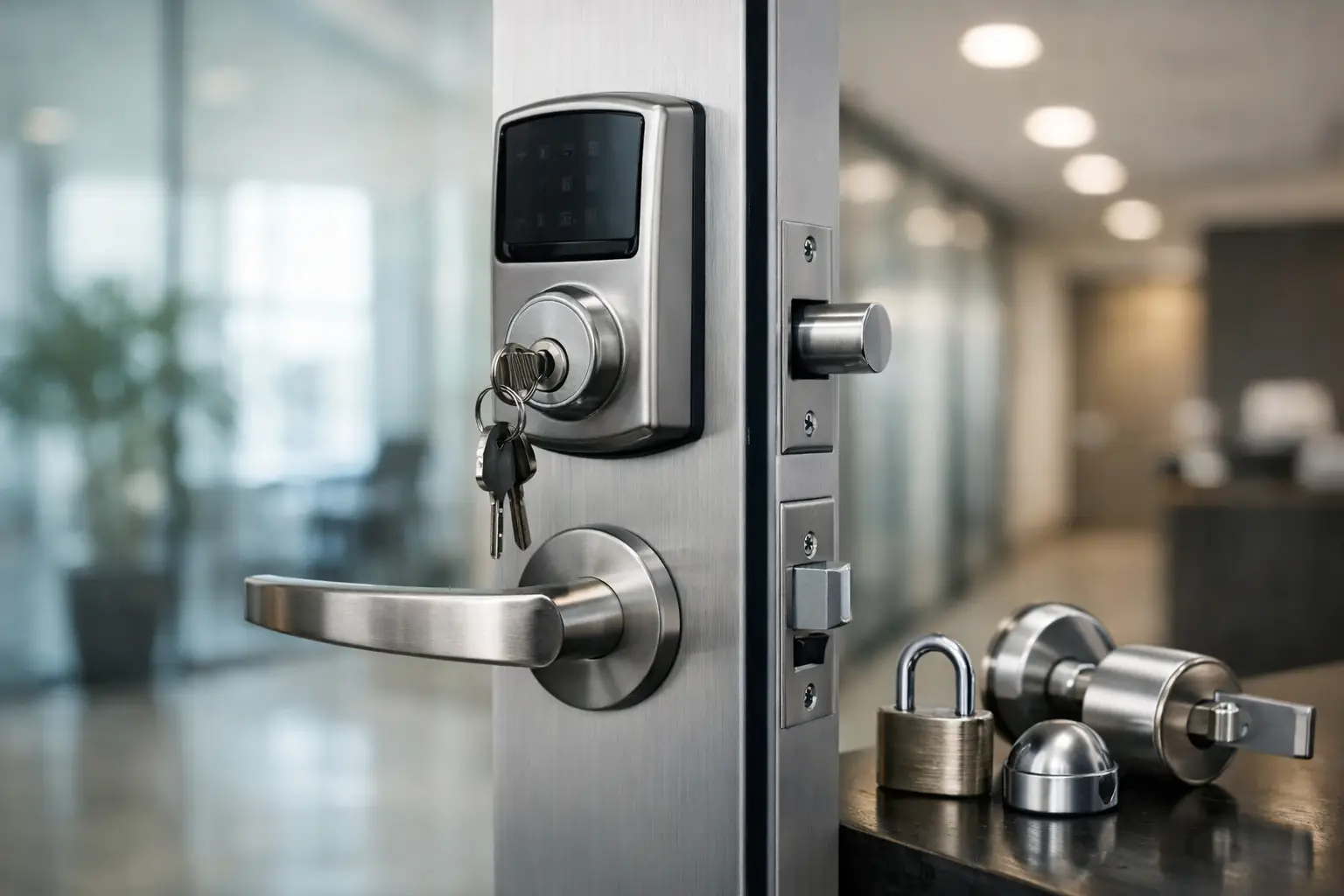
A storefront key that has passed through three former employees is not a small issue. Neither is an office door that only latches if someone pulls it hard, or a back entrance with a lock that jams after every busy shift. Commercial locks are part of your daily operations, not just a piece of hardware on a door. When they fail, your business can lose time, security, and control over who has access.
For Orange County business owners and property managers, the right answer is not always a full lock replacement. Sometimes a repair gets the door working safely. Sometimes rekeying is the fastest, fairest way to remove old key access. The key is matching the solution to the actual risk instead of paying for work you do not need.
Start With the Door and the Risk
A commercial lock has to do more than keep a door closed. It must handle repeated use, employee traffic, deliveries, closing procedures, and sometimes public access. That means a lock that works fine on a rarely used office door may not be right for a restaurant rear entrance or a retail storefront.
First, consider what is behind the door and who uses it. A supply closet, private office, cash room, medical records area, exterior entrance, and shared tenant hallway do not need the same level of control. The more valuable or sensitive the space, the more carefully you should manage keys, credentials, and hardware condition.
Also look at the door itself. A strong lock on a damaged frame, loose strike plate, warped door, or misaligned latch cannot do its job properly. Many lock problems are really door alignment problems. If staff need to slam, lift, pull, or shoulder the door to lock it, the issue deserves attention before the lock or key breaks during a rushed closing.
The Most Common Commercial Lock Options
The best commercial setup depends on your space, traffic level, and budget. There is no single lock that fits every business.
Deadbolts and lever locks
Commercial-grade deadbolts are commonly used on exterior doors where a separate deadbolt provides a strong point of protection. Lever locks are practical for office and interior doors because they are easier to operate than knobs, especially when employees are carrying boxes or supplies.
For an exterior door, a lever lock by itself may not offer the same protection or control you need. The right combination often includes a commercial lever for routine entry and a deadbolt or other secure locking method for closing time.
Storefront and narrow-stile locks
Aluminum glass storefront doors use specialized hardware. Their narrow frames do not accept standard residential-style locks, and their components can wear out from frequent customer traffic. A key that turns loosely, a latch that does not catch, or a cylinder that sticks can leave a business unable to secure the entrance at the end of the day.
Storefront hardware should be serviced with the full door system in mind. The lock, cylinder, pivot, closer, latch alignment, and strike all affect whether the door locks correctly.
Panic bars and exit devices
Exit devices are designed to let people leave quickly in an emergency. They are common on doors with higher occupancy, including restaurants, retail spaces, schools, and warehouses. These devices must operate freely from the inside while maintaining the correct security from the outside.
Do not try to solve a security concern by blocking, chaining, or altering an emergency exit. That can create a serious safety problem and may violate building or fire requirements. If an exit device is loose, sticking, damaged, or not latching, get it checked promptly.
Keypad and electronic locks
Electronic locks can reduce the number of physical keys in circulation. They can be useful when employees change often, when multiple users need different access levels, or when a manager wants to change a code without replacing hardware.
They also come with trade-offs. Batteries need maintenance, codes must be managed carefully, and not every electronic lock is built for heavy commercial use. A low-cost residential keypad on a busy business door may create more service calls than it prevents. For a critical entry, choose hardware rated for the door and expected traffic.
Rekey, Repair, or Replace?
This is where business owners can avoid unnecessary expense. A clear recommendation should explain why a lock needs a particular service, not just present the most expensive option.
Rekeying changes the internal pins in a lock cylinder so old keys no longer work. It is often the right move after employee turnover, a lost key, a tenant change, a contractor who did not return a key, or a suspected copy of a key. If the existing hardware is in good condition and meets your security needs, rekeying is usually faster and less expensive than replacing every lock.
Repair makes sense when the lock is worn, sticking, loose, misaligned, or difficult to operate but the core hardware is still serviceable. A technician may be able to correct the latch alignment, replace a damaged cylinder, tighten hardware, or address the door condition causing the failure.
Replacement is the better choice when the lock is badly damaged, obsolete, repeatedly failing, improperly installed, or no longer appropriate for the door. It may also be necessary if you need a different key system, higher security, emergency exit hardware, or electronic access. Replacing a lock simply because one key is missing is often unnecessary. Keeping an old, unreliable lock because replacement costs money can be the more expensive choice when it causes a lockout or leaves the business unsecured.
Key Control Is the Part Most Businesses Miss
A strong lock loses value when nobody knows how many keys exist. Small businesses often start with one or two keys, then add employees, cleaners, vendors, managers, and temporary staff. Before long, the key count is a guess.
Set a basic policy: know who has keys, record when a key is issued, and collect keys immediately when employment or a contract ends. Avoid leaving labeled spare keys in obvious places such as desks, cash drawers, outdoor planters, or above-door frames. If a master key can open multiple areas, treat it with more care than a standard office key.
Key duplication also deserves a decision. Convenience matters, especially when you run multiple shifts. But unrestricted copying can create a long-term access problem. Depending on your needs, a locksmith can help organize a key system that gives managers, staff, and maintenance personnel only the access they need.
Signs You Should Schedule Service Now
Do not wait for a complete failure if you see patterns. A lock that sticks occasionally tends to stick at the worst possible time. A door that must be forced shut can wear down its locking hardware quickly.
Call for service if keys are hard to insert or remove, the latch does not fully engage, the deadbolt turns with resistance, a lever is loose, the door will not stay closed, or employees have started using workarounds to secure an entrance. A missing key after a breakup, termination, or vendor dispute is also a reason to act quickly.
For an after-hours lockout, break-in damage, or door that will not secure, speed matters. But so does a clear quote before work begins. Fast & Fair Locksmith focuses on direct answers, on-site service, and fair pricing because a business in a security problem should not have to worry about surprise charges too.
Ask the Right Questions Before Work Starts
When you call a locksmith for commercial work, explain what type of door you have, whether it is exterior or interior, what the lock is doing, and whether the building must remain operational. Photos can help identify storefront hardware, panic bars, and specialty locks before a technician arrives.
Ask whether the issue can be repaired, whether rekeying is possible, and what the price includes. A straightforward estimate should distinguish service, parts, and any after-hours charge. If replacement is recommended, ask why the current lock cannot be repaired or rekeyed. You deserve an answer in plain language.
It also helps to plan service around your schedule. A restaurant may need work completed before opening. A medical office may need privacy maintained. A retail store may need a technician after customers leave. The right locksmith works with the realities of your business instead of treating every door like the same job.
A commercial door should close, latch, and lock without a fight. If yours does not, handle it before the next employee is standing outside in the rain, the last person cannot secure the building, or a former keyholder still has access they should have lost weeks ago.